
Studio Visit: Maya Laurent on Møn
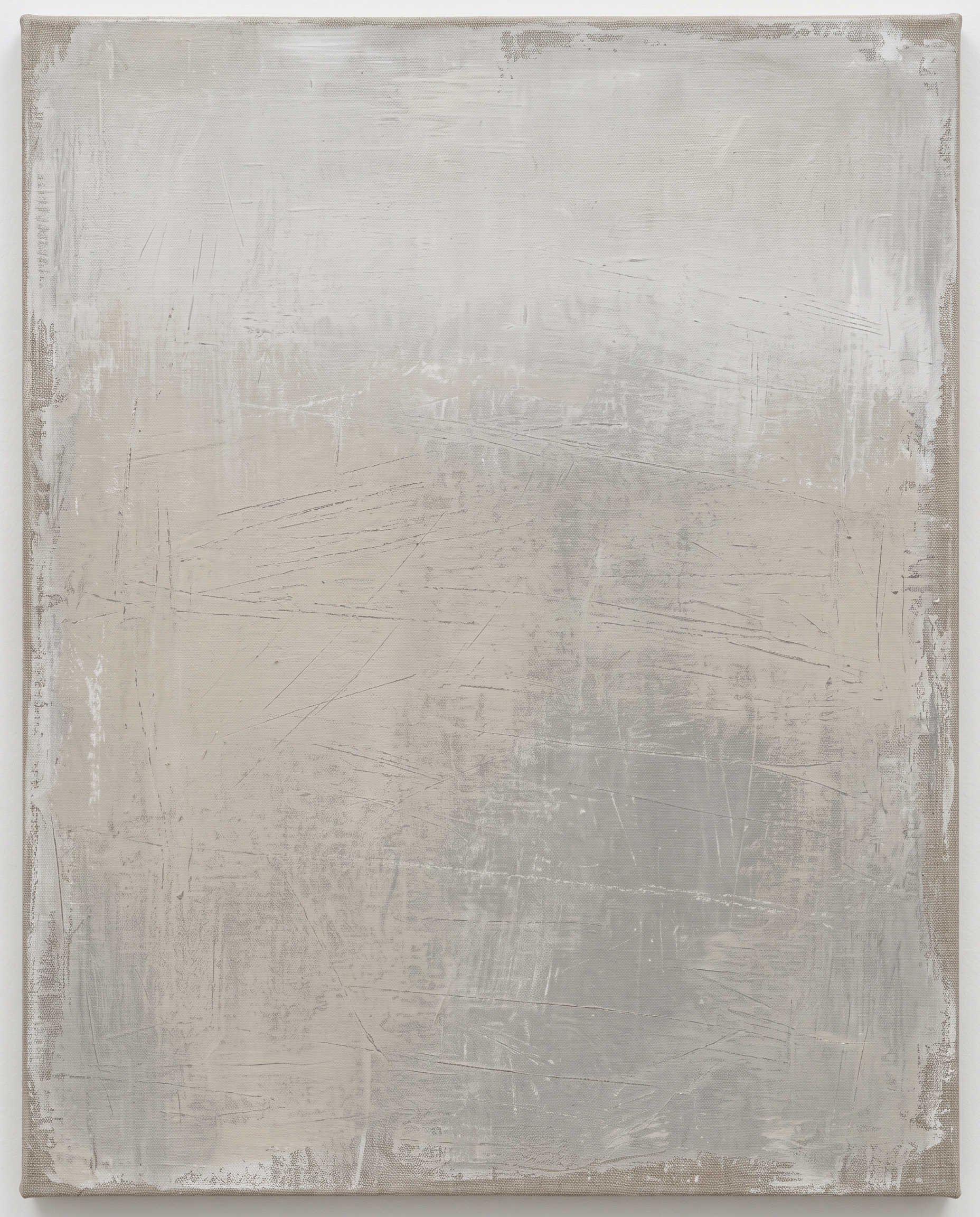
In a converted barn on the Danish island of Møn, Maya Laurent works in a register so narrow it is almost silence, grey against grey, sanded back over weeks until the surface holds light the way weather does.
A portrait of a practice built on slowness, and on paying the kind of attention we have mostly stopped paying.
The barn sits a field back from the water, and in the flat northern light everything inside it is some version of grey. Linen leaning in stacks. A long table of ground pigment in labelled jars. And on the far wall, a painting the size of a door that Maya Laurent has been sanding back, on and off, for most of a year.
“I am interested in the smallest possible difference,” she says. “A grey that is almost another grey. A surface that remembers the hand that made it.” She works slowly, she explains, because the work is about slowness. A single painting on linen might be built up and scraped down a dozen times before it settles. In one of them, ‘Tide Table (Grey to Grey)’, the fourth grey, the one that finally held, is made with ash.
Laurent trained in Copenhagen and Glasgow, and moved early between painting and ceramics. She still treats them as one continuous enquiry: the same attention to surface, tone and time, whether it is pigment on linen or an ash glaze breaking over stoneware. Her recurring motif is the horizon, the seam where two greys touch, drawn less from a specific place than from memory of many.
She keeps two studios: a top-floor room in Copenhagen for paper, ceramics and research, and this barn on Møn for the large linen works and the occasional commission. The island suits the work. “There is not much to look at here,” she says, “which is the point.”
What stays with you, leaving, is the quiet insistence of it, the sense of a practice that has decided, deliberately, to be about less. In a culture of more, Laurent’s archive is an argument for attention.